Magic Level 9 Music Piano Game
- 4.8
- Rating
- 10.00M
- Installs
- Free
- Price
 Analysis by App-foxy
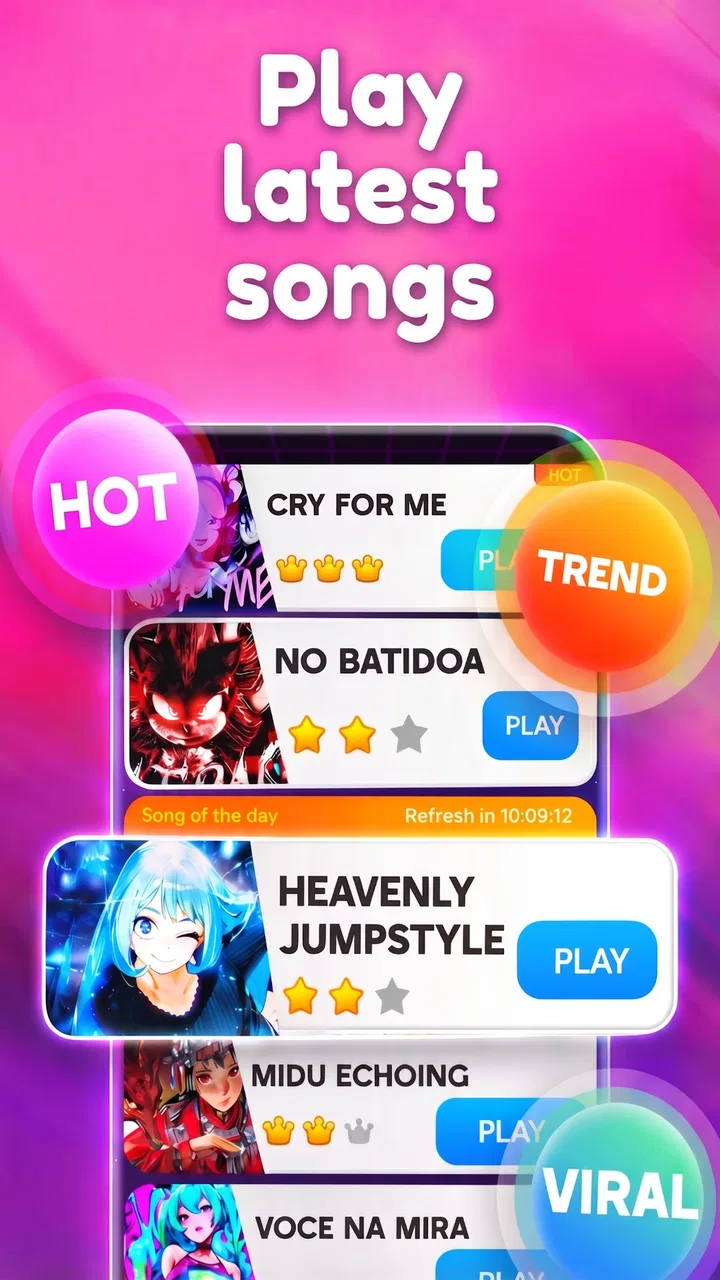
Magic Level 9 Music Piano Game is the kind of music game I can open for a quick break and understand almost immediately. The presentation points me toward rhythm play, while the changing visual themes give each session a little more personality than a plain keyboard exercise. It is a free title from Beatwave Studio, listed for everyone, and its store summary focuses on unlocking rhythm beats and themes for music fans of different ages.
My first impression was that this is built for instant participation rather than a long explanation. That matters on a phone: I do not want to study a complicated interface before I can play a song-like sequence. The central appeal is the connection between what I see and what I hear, with the player expected to react in time. It feels approachable for casual players, children, and anyone who enjoys tapping along without needing musical training.
The game has also attracted a sizable audience, with more than five million installs and a 4.8 average from roughly twenty-nine thousand ratings. Those figures do not make it perfect, but they do suggest that the basic idea is easy for many people to pick up. I would still judge it by the way it fits your habits: this is a light rhythm game, not a replacement for a piano-learning app or a full music-production tool.
You May Also Like

 Blood Strike: 2.5 Anniversary
Blood Strike’s Loadouts Turn Every Drop Into a Tactical Gamble
A close look at Blood Strike’s custom loadouts: how fast access to signature weapons reshapes its battle royale rhythm, rewards preparation, and narrows the gap between fights.

 Pandora - Music & Podcasts
Pandora’s Music Is Easy to Start, but Harder to Recover
Pandora’s strength is its low-effort path from a seed to a station. Its weak spot is how much confidence it asks you to place in connection, setup, and quiet recovery.

 8 Ball Pool
 Is Built on Rivalries, Rematches, and Routine
A close look at the rivalries, rematches, shared routines, and unanswered safety questions that turn a quick pool match into a persistent mobile community.

 Samsung Music
’s Quiet Strength Is Playing What You Already Own
Its reach comes less from spectacle than from dependable access to a personal library. That simplicity is both the app’s strongest retention engine and its ceiling.

 AccuWeather: Weather Radar
AccuWeather Review: A Quick, Clear Forecast for Everyday Decisions
For everyday plans, the best forecast is the one you can understand quickly. AccuWeather makes rain timing, radar, and local conditions easy to act on, with a few trade-offs.

 Hill Climb Racing
Why Hill Climb Racing Still Turns Crashes Into One More Run
A tiny car, a bumpy hill and one more upgrade: Hill Climb Racing keeps resurfacing because its simple chaos makes every near-miss feel personal.
More From Our News Desk
View All News


How the visual world supports the play
The art direction is most useful when it stays out of the way of the timing. In a game based on quick visual reactions, decorative elements need to create mood without making the playable area confusing. Magic Level 9 Music Piano Game aims for that balance through its theme-focused presentation. The result is a game that feels more like a small musical scene than a bare grid of buttons.
I like the idea of unlocking themes because it gives visual progress a purpose. A new look can make familiar actions feel refreshed, especially when I am playing in short bursts. This is a subtle reward rather than a deep story, but it suits the format. The setting is not trying to build a huge fictional world; instead, it frames each round as a compact performance with its own visual tone.
That approach also explains why the game works best when I treat it as a mood-based pastime. I can play while waiting for transport, during a short rest, or when I want something more active than listening to music but less demanding than a strategy game. The themes help separate one session from another, even when the underlying action remains familiar.
There is a trade-off here. Players who want detailed environments, characters, or a narrative campaign may find the presentation too focused on surface style. The visual world exists to support rhythm and replay, not to reward close exploration. I would choose a story-driven music game instead if my main reason for playing were discovery, dialogue, or a sense of place that develops over many hours.
Reading the screen before chasing a high score
A useful habit is to spend the first few attempts learning the visual language instead of immediately trying to play as fast as possible. Notice which elements are interactive, how the next beat is presented, and whether the theme changes the contrast around the play area. This small adjustment can make the game feel less frantic, particularly for younger players or anyone who is new to touch-based rhythm games.
I also recommend choosing a comfortable brightness and holding the phone steadily. That may sound obvious, but timing games punish small distractions. A busy background, glare, or an awkward grip can make a simple sequence feel harder than it really is. The visual design works best when I give the action most of my attention and let the theme remain a supporting layer.
The age rating of Everyone makes the game suitable for a broad audience, but suitability is not the same as universal appeal. A child may enjoy the bright, immediate feedback, while an experienced rhythm player may want more depth and precision. Parents looking for a gentle first music game should find the concept approachable; players seeking advanced musical technique should keep their expectations modest.
Sound, timing, and the feeling of a playable song
Sound is the part that gives the tapping a reason to exist. Without an audible pulse, the experience would become a visual reflex test. In this game, the intended pleasure comes from matching action to rhythm, so I find it more satisfying when I listen instead of relying only on the screen. That turns each round into a small coordination exercise rather than random tapping.
The best way to approach it is to let the beat guide the hand. I try not to stare exclusively at the next visual cue, because doing so can make my timing tense and mechanical. Listening for the pulse helps me anticipate movement and makes mistakes feel like missed musical entries rather than arbitrary failures. This is one of the more useful skills the game encourages: connecting visual reaction with an audible pattern.
The store description presents the title as a game for music lovers of all ages, and I think that is most accurate when “music lover” means someone who enjoys interactive rhythm. It is not the same as practicing scales, learning notation, or developing finger independence on a real instrument. The game can sharpen attention and timing in a playful way, but I would not use it to measure genuine piano ability.
The pacing is important. A rhythm game loses its charm if every moment feels equally intense. Short, readable sequences allow me to settle into the beat, while faster or less forgiving moments create a natural rise in pressure. Even when the mechanics stay simple, that change in pace can make a session feel like a miniature musical arc: entry, concentration, tension, and release.
A practical listening routine
For a better first session, I would play with sound enabled, start at a relaxed pace, and avoid treating every mistake as a reason to restart immediately. Letting a round continue can reveal how the rhythm develops and whether the difficulty comes from speed, visual reading, or simple inattention. After that, I would replay the same style of sequence and focus on one improvement at a time.
This method is especially helpful when sharing the game with someone else. One person can play while another listens, then they can switch. That makes the experience social without requiring a competitive setup. It also gives beginners permission to learn the timing gradually instead of feeling that they must perform perfectly on the first attempt.
There is a practical limitation for anyone who usually plays mobile games silently. The visual cues may still make the game usable, but the musical identity becomes weaker when the audio is turned off. I would pick a quiet puzzle game for situations where headphones or phone sound are not appropriate. This title makes the most sense when its audio and visual feedback can work together.
Where the mechanics fit—and where they do not
The mechanical appeal is immediate: watch, listen, react, and try to maintain the sequence. That loop is easy to explain and easy to revisit. I do not need a long play session to feel that I have accomplished something, which is a major strength for a phone game. A few minutes can be enough to reset my attention after work or fill an awkward gap in the day.
Its accessibility is also its main limitation. Players who enjoy rhythm games for complex patterns, deep customization, or demanding mastery may reach the edge of the experience sooner than casual users. The theme-unlocking structure adds motivation, but visual rewards alone may not satisfy someone who wants a large skill tree or a serious progression system.
I would recommend it to three kinds of players in particular: someone discovering mobile rhythm games, a family wanting a simple music-themed activity, and a casual player who likes compact sessions with a sense of visual progression. It is also a reasonable choice for people who enjoy testing hand-eye coordination without committing to a lengthy campaign.
I would skip it if your priority is authentic instrument education, detailed song arrangement, or a competitive rhythm community. A piano-learning application is better for lessons and technique. A music-creation application is better for composing and recording. A more advanced rhythm title is better if you want dense patterns, precise scoring, and long-term mastery. Magic Level 9 Music Piano Game occupies the lighter, more immediately playable end of the category.
Using the game in an everyday routine
Imagine having ten minutes before an appointment. I would play one or two rounds, concentrating on steady timing rather than chasing a perfect result, then stop before the session becomes tiring. That short format is where the game feels most natural. It gives me a focused activity with a musical pulse, but it does not demand that I remember a complicated story or rebuild a strategy after putting the phone down.
For a longer session, I would vary the purpose. I might begin by warming up with familiar patterns, then spend a few attempts working on reactions, and finish by exploring a newly available visual theme. This prevents the play from becoming a repetitive test of speed. The important insight is that the visual unlocks can be used as pacing markers: they give me a reason to alternate focused attempts with relaxed ones.
Another useful approach is to play with different levels of attention. On a casual attempt, I can enjoy the colors and general rhythm. On a serious attempt, I can reduce distractions, listen closely, and watch the timing cues with purpose. The same game therefore supports both low-pressure entertainment and a modest coordination challenge, although it should not be mistaken for a full training program.
Because the game is free, it is easy to try without making it a major commitment. That makes it a good recommendation when a friend asks for a simple music game rather than a large download with a steep learning curve. Still, “free” does not automatically mean it will suit every player. The right question is whether you enjoy repeating short rhythm actions and unlocking presentation changes, not whether you are looking for a complete piano experience.
Version, access, and who should install it
The current version is 1.8.0, and the game supports devices running Android 7.0 or newer. That broad compatibility makes it practical for people who do not use the latest phone. I would still pay attention to how comfortably the game runs on an older device, because rhythm play depends on responsive touch input and consistent audio timing. A game can be simple to understand yet unpleasant if the phone introduces delays.
As a free music game, it is easy to recommend as a low-risk experiment. I would install it for a child who wants something more interactive than a music player, for a friend who likes tapping games, or for myself when I want a brief change of pace. The Everyone rating supports its broad positioning, while the large player base indicates that the basic format has wide appeal.
Beatwave Studio has kept the concept focused: rhythm, themes, and quick interaction. That focus is valuable because the game does not need a complicated premise to deliver its central pleasure. At the same time, anyone expecting a substantial album, a realistic piano simulator, or an extensive narrative should choose a different kind of application. Knowing that boundary will prevent disappointment.
One question many new players will have is whether they need musical knowledge. In my experience, no. The game is built around listening and reacting, not reading notation or understanding chords. Another likely concern is whether it works for short sessions; that is one of its strongest fits. The more demanding question is whether it offers enough depth for dedicated rhythm fans, and my answer is more cautious: the accessible design may be more appealing than the long-term challenge.
My atmosphere verdict
What stays with me is the way the game joins three modest ideas into one coherent mood. The themes provide visual identity, the sound gives the taps a pulse, and the pacing turns simple reactions into a small performance. None of these elements needs to be enormous. They only need to support one another, and that is where the game is most successful.
The strongest reason to try it is the clean connection between listening, watching, and responding. I can recommend it to casual players who want a friendly rhythm experience with a little visual progression. It is especially effective as a short break, a first introduction to music games, or a shared activity with someone who does not want complicated controls.
My reservation is equally clear: the same simplicity that makes it welcoming may leave advanced players wanting more. If your goal is to learn piano, compose music, or master highly technical rhythm charts, this is not the right destination. If you want a free, approachable game that creates a focused musical mood in a few minutes, it is a convincing option.
With an average of 4.8 from around twenty-nine thousand ratings, Magic Level 9 Music Piano Game has clearly connected with many players. I would not install it because of that number alone; I would install it because its compact rhythm loop matches a real everyday need. It turns spare minutes into a small audiovisual challenge, and when the timing, sound, and theme line up, that simple idea can be genuinely satisfying.
FAQs for Magic Level 9 Music Piano Game
01What is Magic Level 9 Music Piano Game?
Magic Level 9 Music Piano Game is a rhythm-based music game designed for Android and iOS devices. Players tap on tiles to the beat of various songs, ranging from classical compositions to modern hits. The game offers levels of increasing difficulty, engaging players with its dynamic and challenging gameplay.
02Is Magic Level 9 Music Piano Game free to play?
Yes, Magic Level 9 Music Piano Game is free to download and play. However, it contains in-app purchases that enhance the gaming experience, such as unlocking additional songs and removing ads. Players can choose to enjoy the game without spending money, but certain features may require payment.
03What are the main features of Magic Level 9 Music Piano Game?
The game features a wide selection of songs across multiple genres, intuitive touch controls, and visually appealing graphics. It also includes a competitive leaderboard, allowing players to compare their scores with others globally. Regular updates introduce new songs and challenges, keeping the gameplay fresh and exciting.
04Can I play Magic Level 9 Music Piano Game offline?
Magic Level 9 Music Piano Game does offer offline play for most of its content. However, some features, like leaderboards and downloading new songs, require an internet connection. Playing offline is a great way to enjoy the game on the go without using data, but for a full experience, periodic online access is beneficial.
05Does Magic Level 9 Music Piano Game support multiple languages?
Yes, Magic Level 9 Music Piano Game supports multiple languages, making it accessible to a global audience. The game interface, including menus and instructions, is available in several languages. This feature ensures players worldwide can enjoy and navigate the game comfortably, enhancing their overall experience.
Pros
- Engaging user interface with vibrant visuals.
- Wide variety of songs across different genres.
- Adaptive difficulty keeps players challenged.
- Smooth and responsive touch controls.
- Regular updates with new music tracks.
Cons
- Occasional ads can interrupt gameplay flow.
- Requires internet for some features.
- In-app purchases can be costly.
- Limited offline song availability.
- High battery consumption during long sessions.

Magic Level 9 Music Piano Game
Gallery